Old Film Projectors: History, Value & Where to Buy
Film projectors work by shining light through a moving strip of film — advancing frame by frame at 16 to 24 frames per second — to project a sequence of images that creates the illusion of motion. The history stretches from Eadweard Muybridge's Zoopraxiscope in 1879 to the Super 8 home projectors of the 1960s and 70s, with vintage models still available today through eBay and estate sales.

Film projectors may no longer be a household staple, but old movie projectors are still sought after by collectors, film enthusiasts, and families who want to experience home movies as they were originally shown. If you have found a vintage film projector or are thinking about buying one, the main questions are what format it plays, whether it works safely, and whether replacement parts are available. This guide covers the history, main projector types, value, buying options, and safe use.
A Brief History of Film Projectors
Projection technology existed long before motion-picture film. Early devices such as the magic lantern used light and lenses to project still images. In 1879, Eadweard Muybridge demonstrated the Zoopraxiscope, an important step toward motion-picture projection.
By the 1890s, photography, flexible film, and mechanical projection came together to make public movie screenings practical. 35mm became the dominant theatrical format, while later formats brought projection into schools and homes. Capture’s guide to old home movie formats explains how these formats evolved before videotape and digital recording took over.
Year | Development |
|---|---|
1879 | Muybridge demonstrates the Zoopraxiscope |
1890s | Practical motion-picture projection systems emerge |
1923 | Kodak introduces 16mm film |
1932 | Kodak introduces Standard 8 film |
1965 | Kodak launches Super 8 |
Types of Old Film Projectors
Not every projector can play every reel. 35mm, 16mm, Standard 8, and Super 8 use different film dimensions and perforations.
Projector type | Film format | Typical use |
|---|---|---|
35mm | 35mm film | Commercial theaters |
16mm | 16mm film | Schools, institutions, filmmakers |
Standard 8 | 8mm film | Family home movies |
Super 8 | Super 8 film | Home movies and amateur filmmaking |
Dual 8 | Standard 8 + Super 8 | Playing both common 8mm formats |
35mm and 16mm Film Projectors
35mm projectors were built mainly for commercial cinemas. The smaller 16mm format was easier to use outside theaters and became common in schools, churches, businesses, the military, and among filmmakers.
8mm Film Projectors
Kodak introduced Standard 8mm film in 1932 as a more affordable home movie format. Families could record birthdays, vacations, and everyday moments, then watch them later with a small projector.
Brands such as Kodak, Bell & Howell, Keystone, Bolex, and Eumig produced home movie projectors during the format’s peak. For equipment made specifically for this format, see Capture’s guide to 8mm film projectors.
Old reels can become brittle or damaged with age. If preservation matters more than recreating the original projection experience, you can convert 8mm film to digital without repeatedly feeding the original reel through an aging machine.
Super 8 Film Projectors
Kodak introduced Super 8 in 1965 with an easier cartridge-based camera system and a larger image area than Standard 8. It became one of the defining home movie formats of the late 1960s and 1970s. Capture’s Super 8 projector guide covers several options still found on the secondhand market.
Some Super 8 film also carried magnetic soundtracks. Capture’s guide to what Super 8 film is can help identify an inherited reel.
Standard 8 and Super 8 are both about 8mm wide, but their perforations and frame sizes differ. A projector must support the format you have. If you own both, a dual-format projector is usually simplest. You can also compare 8mm vs. Super 8 film before loading an unfamiliar reel.
Where to Buy an Old Film Projector
Vintage film projectors are still available, but condition varies. The best place to buy depends on whether you want a collectible or a machine you plan to use.
Where to buy | Best for | What to watch for |
|---|---|---|
eBay | Large selection | Many units are untested |
Facebook Marketplace/Craigslist | Local inspection | Limited buyer protection |
Estate sales/flea markets | Bargains | Often sold as-is |
Antique stores | Collectibles | Condition may be unknown |
Specialist film dealers | Serviced equipment | Usually more expensive |
A projector that has been serviced and tested with film is much safer than one described only as “powers on.”
What to Check Before Buying a Vintage Projector
Before buying, confirm:
Film format: Standard 8, Super 8, 16mm, or 35mm
Whether it has actually been tested with film
Condition of belts, gears, rollers, sprockets, and the film gate
Availability of replacement lamps
Whether it supports sound, if needed
Correct voltage for where you live
Availability of parts and repair services
Whether a manual is available
Return policy for online purchases
Are Old Film Projectors Worth Anything?
Yes, but age alone does not make a projector valuable. Value depends on the manufacturer, exact model, format, working condition, sound capability, accessories, rarity, and collector demand.
An untested home projector may have modest resale value, while a serviced Super 8 sound projector or desirable 16mm machine can be worth considerably more. Original cases, manuals, reels, lenses, and accessories can also increase collector appeal.
To estimate value, search the exact manufacturer and model number and compare completed or sold listings, not only asking prices.
How to Maintain an Old Film Projector
Vintage equipment needs careful maintenance, especially before you use it with irreplaceable film.
Clean the film gate, rollers, guides, and sprockets.
Inspect belts and rollers for cracking or deterioration.
Clean the lens with products intended for optical surfaces.
Check that the take-up reel turns smoothly.
Do not automatically lubricate a projector. Follow the manual for the exact model.
Stop immediately if it jams, slows down, pulls unevenly, or makes unusual noises.
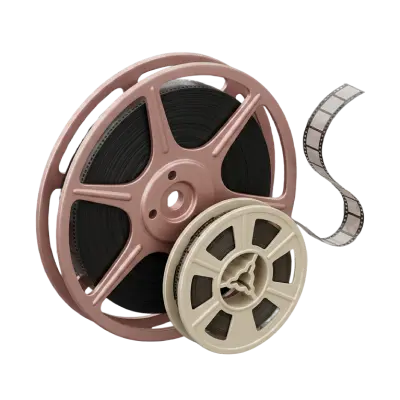
Capture’s guide to film reels explains the basic components used during playback.
Is It Safe to Play Old Film on a Vintage Projector?
It can be, but the condition of both the projector and the film matters. Older film can become brittle, warped, shrunken, or damaged around its perforations and splices.
Shrinkage matters because even a small dimensional change can prevent sprockets from aligning correctly. Capture’s guide to film shrinkage and projection explains why damaged or shrunken reels can jam or tear.
Before projecting an important reel, inspect it for broken perforations, loose splices, warping, brittleness, or a strong vinegar-like odor. Never force film through a projector that is not moving smoothly.
For irreplaceable footage, creating a digital copy before repeated projection is the safer approach. Capture’s film transfer service converts 8mm, Super 8, and 16mm film to digital while returning the original reels.
Common Problems With Old Projectors
Typical problems include:
Worn or stretched belts
Burned-out lamps
Hardened grease
Worn gears or rollers
Dirty film gates
Film jams or uneven speed
Auto-threading failures
Sound playback problems
Basic cleaning or belt replacement may solve some issues, but complex electrical or mechanical work is better left to someone experienced with vintage film equipment.
Old Film Projectors Still Have a Place
Digital technology replaced film projection in most homes and theaters, but old projectors have not disappeared. Collectors restore them, filmmakers enjoy analog equipment, and families still use them to recreate the experience of watching home movies on a screen.
A vintage machine can often be repaired or replaced, while a one-of-a-kind family reel cannot.
If you want the original projection experience while protecting the footage, digitizing gives you both options. Capture can preserve 8mm, Super 8, and 16mm film as digital copies while returning the originals.
Frequently Asked Questions
When were movie projectors invented?
Motion-picture projection developed during the late 1800s. Muybridge’s Zoopraxiscope appeared in 1879, while practical systems for public audiences emerged during the 1890s.
What is an old movie projector called?
Old projectors are usually identified by format, such as a 35mm, 16mm, 8mm, or Super 8 projector. You may also see vintage movie projector, antique film projector, or reel projector.
Can an 8mm projector play Super 8 film?
Not necessarily. Standard 8 and Super 8 have different perforation and frame designs. You need a compatible or dual-format projector.
Can you still buy old film projectors?
Yes. Vintage projectors are available through online marketplaces, specialist film dealers, estate sales, antique stores, and local secondhand sellers.
Should I digitize my film before projecting it?
For irreplaceable footage, it is a good precaution. Projection puts film through a mechanical transport system, so creating a digital copy first reduces the risk to the original.
Bring your memories back to life.
You May Also Like

How to Scan Film Negatives: The Complete Guide (DIY vs. Professional)
The best way to scan film negatives depends on your collection, budget, and the quality you want. Compare DIY methods with professional scanning, learn which option works best for 35mm, 110, APS, and medium format film, and see when Capture provides the best results.

Why Is My Old Film Pink? Causes, Restoration, and Preservation Tips
Old film turns pink or magenta because color film contains three dye layers — cyan, magenta, and yellow — and the cyan and yellow layers break down much faster than the magenta layer. As those two dyes fade, magenta becomes dominant, giving the footage its characteristic pink or red cast. This is called color dye fading, particularly Eastmancolor stocks manufactured before Kodak introduced low-fade film stocks in the early 1980s.. The effect is permanent and progressive, but much of the original color can still be recovered digitally if the film is scanned before fading becomes too severe.

How to View 8mm Film Without a Projector
The most reliable way to view 8mm film without a projector is professional digitization, which converts each frame into a digital file watchable on any device. Smartphone apps and DIY lightbox setups exist but cannot replicate motion or deliver consistent results. Professional scanning is the only method that produces watchable footage.