How Much Does It Cost to Convert VHS to Digital?
Professional VHS to digital conversion typically costs between $10 and $25 per tape depending on the service and turnaround time. DIY conversion using a capture device costs $30 to $150 upfront in equipment but requires a working VCR and significant time investment. For large collections, professional services become more cost-effective once the time required for real-time tape playback is factored in.

Converting a VHS tape to digital costs between $20 and $40 per tape at a professional mail-in service, or $100 to $400 upfront if you go the DIY route. The right choice depends on how many tapes you have, the quality you want, and how much time you can realistically invest. For most families with more than five tapes, a professional VHS to digital conversion service delivers better results at a lower total cost than it might first appear.
With over 25 years of experience digitizing home movies for more than 12 million customers, Capture has put together a complete breakdown of what VHS conversion actually costs in 2026 — including where pricing varies, what to watch out for, and how to choose the right service for your collection.
What Affects the Cost to Convert VHS to Digital
The biggest variable is the method you choose. Professional services and DIY setups have completely different cost structures, and within each category, a handful of factors determine the final number.
For professional services, pricing is shaped by the number of tapes, the output quality tier (standard definition, Full HD, or 4K), whether you want a physical USB drive, shipping, and which company you use. One thing worth knowing upfront: some services charge by tape runtime rather than per tape — a 2-hour VHS tape billed at $8 per 30 minutes of footage works out to $32, even if the advertised rate looked lower. Services that charge a flat rate per tape regardless of length are much easier to budget for.
For DIY setups, the main costs are equipment and time. You'll need a working VCR, a video capture device, and storage for the files. Each tape also has to be captured in real time, so a box of 20 tapes is a 40-plus-hour project before you account for any file organization or editing.
DIY Conversion: What It Costs and What It Gets You
Recording Directly from a VCR or Camcorder
The lowest-cost method is to play your tape on a VCR or vintage camcorder and record the output with your phone or a digital camera. If you already have the equipment, the only cost is your time. The trade-off is quality: you're making a recording of a recording, which degrades the image further. This approach works for a quick preview, but it's not a reliable archiving method.
If you don't already own a VCR, expect to spend $30 to $300 on the secondhand market. New VCRs are no longer manufactured — production stopped in 2016 — so anything you buy is aging hardware with no warranty or parts support.
Using a VHS Capture Card or Converter
A more controlled DIY approach connects your VCR to a computer through a video capture card, which records a proper digital file. Our VHS converter guide reviews seven devices and identifies the three best for home use. Capture cards typically cost $50 to $300, depending on quality, and you'll still need a working VCR on top of that.
The practical challenges are worth understanding before you commit. Capture cards require some configuration; output quality depends heavily on the condition of both your VCR and your tapes, and the capture process runs in real time. You'll also need storage — a 2-hour VHS tape produces roughly 8–15 GB as a raw file, which means budgeting another $10 to $300 for external drives or cloud storage.
Total estimated cost for DIY: $100–$400, depending on what equipment you already own. Quality varies from acceptable to poor, and the process requires meaningful time investment.
Professional VHS Transfer Services: What You Actually Pay
A professional service handles the transfer, encoding, and delivery while you pack and ship your tapes. The per-tape cost is higher than DIY equipment on a per-unit basis, but the results are consistently better — and for a collection of more than five or six tapes, the time savings alone often justify the price.
Per-Tape Pricing
At Capture, pricing is tiered by quality and charged per tape regardless of how long the tape runs:
SD (480p): $19.99 per tape — faithful to the original VHS quality, no upscaling
FHD (1080p): $29.99 per tape — AI-enhanced upscaling with noise reduction and color correction
UHD (4K): $39.99 per tape — maximum AI upscaling for cinematic quality
Unlike most digitization services, Capture processes footage through a ProRes intermediate master and applies frame-by-frame AI upscaling for FHD and UHD orders — de-interlacing CRT artifacts while preserving the original frame rate. Standard services like ScanCafe deliver 720×480 SD output at $28.00 per tape. LegacyBox uses bundle-based pricing with effective per-tape costs typically ranging from $25 to $35, depending on which kit size you buy.
Shipping and Add-Ons
Capture includes a prepaid UPS label starting at $12.99 one-way or $24.99 round-trip. A USB drive with all your files is available as an add-on at $14.99. Every order includes 90 days of free cloud access through MemoryCloud, so you can stream and download your videos from any device before deciding whether you want a physical copy.
What File Format You Receive
Your digitized videos are delivered as MP4 files — compatible with every modern device, editing program, and streaming platform. Capture also integrates with Google Photos, so your files can sync automatically to your existing library if you choose.
If you specifically want VHS to DVD rather than digital files, some services still offer that option at an additional fee. Most have shifted toward USB and cloud delivery, so if a physical disc matters to you, confirm availability before ordering.
Turnaround Time
Capture processes most orders in 2–3 weeks from receipt. ScanCafe takes 3–4 weeks. Some services run 8 weeks or longer during busy periods.
This matters more than it might seem. VHS tapes lose 10–20% of their signal quality per decade, and once magnetic degradation passes a certain threshold, tape repair can only do so much. A tape from 1990 has already been sitting for 35 years. The difference between sending it out now and putting it off another year is real.
Choosing the Right VHS Conversion Service
If you're comparing companies that convert VHS to digital, five factors matter most beyond price.
Where is the work done? Some services outsource transfers to third-party labs, which adds shipping risk and reduces accountability. Capture digitizes every tape at its own facility in Norcross, Georgia — your originals never leave the building except to come back to you. ScanCafe processes in-house at its Indianapolis lab. If a service doesn't tell you where the work happens, that's worth asking.
What security measures are in place? Capture uses barcoded tracking for every tape and 24/7 monitored, climate-controlled storage throughout the process. ScanCafe weighs packages to the gram on arrival and departure and records the process on 60 HD surveillance cameras. Both are meaningfully more rigorous than the basic order tracking most smaller services provide.
What does the pricing actually include? Read the pricing page carefully. Some services charge for cloud access as an ongoing subscription — meaning you pay monthly to access files you've already paid to have digitized. Others bundle add-ons that look optional in the order flow but appear in the final total. The most common complaints in Legacybox reviews involve pricing surprises at checkout.
What's the turnaround guarantee? Stated turnaround times and actual turnaround times don't always match, particularly at high-volume services during peak periods. Check recent customer reviews, not just the company's own claims.
How long has it been operating? Capture has worked in this space since 1999 — 25+ years. That track record matters when you're shipping irreplaceable material.
One practical note: find an alternative. Walmart and CVS still offer drop-off services in some locations, though turnaround times are typically longer than mail-in options.
Why Converting Now Matters
VHS tapes were never designed to last forever. They're magnetic tape wound on plastic spools, and every passing year means slightly more signal loss, slightly more risk of mold or humidity damage, and slightly fewer working VCRs to play them back. Finding a VCR for sale has become genuinely difficult — and a professional digitization lab uses broadcast-grade decks that will outperform any secondhand consumer VCR regardless.
Digital files don't have any of these problems. An MP4 stored in the cloud or on a hard drive today will play identically in 2046. The cost of VHS-to-digital conversion is a one-time expense; the degradation on a VHS tape is continuous.
Frequently Asked Questions
How much does it cost to convert VHS to digital? Professional mail-in services charge $19.99–$39.99 per tape at Capture, depending on whether you select SD, 1080p, or 4K output. ScanCafe charges $28.00 per tape for standard-definition transfers. DIY setups cost $100–$400 upfront in equipment.
What is the cheapest way to convert VHS to digital? The lowest upfront cost is a basic USB capture card ($50–$100) connected to a secondhand VCR. For a single tape or two, that may make sense. For most families with five or more tapes, professional SD conversion at $19.99 per tape is cheaper overall once you factor in equipment, storage, and time.
How long does VHS to digital conversion take? Capture completes most orders in 2–3 weeks from receipt. ScanCafe takes 3–4 weeks. DIY conversion runs in real time — a 2-hour tape takes at least 2 hours to capture, plus file processing and organization.
What file format will I receive? MP4 is the standard delivery format at professional services, including Capture. It plays on every modern device — phones, computers, smart TVs, and streaming platforms — without any conversion needed.
Can I convert VHS to DVD instead of digital? Some services still offer DVD output, though most have shifted to USB and cloud delivery. If a physical disc matters to you, confirm availability when comparing providers, as some no longer offer it or charge an additional $10–$20 fee.
What if my tapes are damaged or degraded? Most professional services, including Capture, include basic tape repair — broken cases, loose reels — at no extra charge. If a tape fails to transfer at all, Capture does not charge for it.
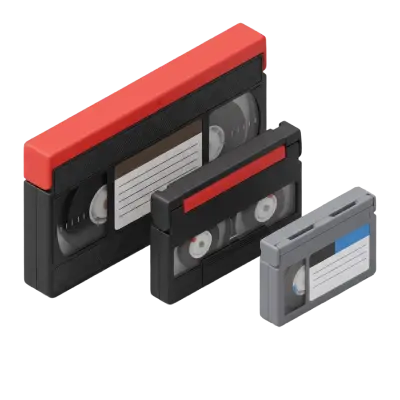
Can I convert other tape formats at the same time? Yes. Capture handles most major tape formats including VHS-C, Hi8, MiniDV, Betamax, Digital8, and DV in a single order. Film formats — Super 8, 8mm, and 16mm — are also available, as are photo scanning services.
Bring your memories back to life.
You May Also Like
How AI Video Upscaling Works: De-interlacing, Noise Reduction, and Resolution Scaling Explained
AI video upscaling works in three stages: the original tape is captured using broadcast-grade equipment to extract the cleanest possible signal, encoded into a lossless ProRes master file, then processed frame-by-frame by neural networks that remove interlacing artifacts and increase the resolution to 1080p or 4K. Unlike a standard 1:1 transfer, the AI analyzes each frame individually — inferring missing detail from surrounding pixels and learned patterns — while preserving the original frame rate throughout.

Choosing the Perfect Film Video Camera: Top 10 Recommendations for Filmmakers
Film video cameras record motion by capturing a rapid sequence of still images on photographic film — typically at 24 frames per second for cinema and 16–18 fps for home formats like 8mm and Super 8. Unlike digital video, film requires chemical development before it can be viewed, and the footage degrades over time without proper cold, dry storage.

Five Super 8 Projectors That Stand the Test of Time
Super 8 projectors operate similarly to standard 8mm projectors but are not interchangeable — Super 8 film has a different sprocket hole size and frame dimension than regular 8mm. Kodak introduced Super 8 in 1965 alongside a cartridge-loading system that eliminated manual threading. Working Super 8 projectors are available used through eBay and estate sales, though lamp replacements are increasingly difficult to source.