How Film Shrinkage Affects Playback and Projection
Film shrinkage occurs as acetate or nitrate film loses moisture over decades, causing the strip to contract and pull away from its sprocket holes. Shrunken film jams in standard projectors and scanners, risking physical tears during playback attempts. Shrinkage beyond 1% typically requires specialized equipment to digitize safely. Cold, humidity-controlled storage slows the process, but once significant shrinkage has occurred, professional intervention is necessary to recover the footage.

Film shrinkage is one of the most serious and misunderstood forms of motion picture film deterioration. Unlike surface damage such as scratches or dust, shrinkage affects the physical dimensions of the film itself, permanently altering its size, flexibility, and mechanical behavior. Once shrinkage begins, it cannot be reversed, and improper handling can result in catastrophic loss of irreplaceable footage.
Understanding how film shrinkage happens, how to recognize it, and how to handle affected reels safely is essential for anyone preserving home movies, archival film, or historical recordings.
What Is Film Shrinkage?
Film shrinkage occurs when the base material of the film contracts over time due to chemical degradation. Motion picture film is composed of several layers, including the base (typically acetate or polyester) and the emulsion layer that contains the image. As the base ages, it slowly loses plasticizers and moisture, causing it to tighten and become shorter than its original manufactured length.

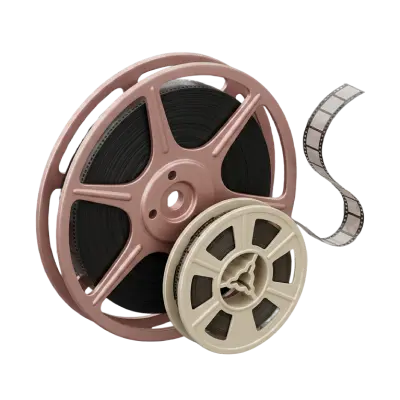
Film reels can appear visually intact even as internal deterioration begins.
This dimensional change may appear minimal, often measured in fractions of a percent, but even small amounts of shrinkage can render film unsafe to project or scan using standard equipment. Film and projectors are engineered to precise tolerances. When the film no longer conforms to those dimensions, mechanical stress increases dramatically and can shorten the time a film lasts once deterioration has begun.
Film Types Most Affected by Shrinkage
Film shrinkage does not affect all film stocks equally. The level of risk depends largely on the chemical composition of the film base.
Acetate Film
Acetate-based film is by far the most vulnerable to shrinkage. It was widely used for:
- 8mm film
- Super 8 film
- 16mm film
- Some 35mm film
Acetate film is chemically unstable and prone to hydrolysis, a reaction with moisture that accelerates deterioration. Shrinkage in acetate film is often closely linked to vinegar syndrome, though it can occur even before a strong odor is present.
Polyester Film
Polyester film is far more stable and resistant to shrinkage. It is commonly found in later professional and archival formats. While polyester film can still suffer from physical damage or emulsion issues, true shrinkage is rare compared to acetate.
Why Film Shrinkage Happens
Film shrinkage is primarily driven by chemical aging, but several environmental and handling factors accelerate the process.
Loss of Plasticizers
Plasticizers are added during manufacturing to keep the film flexible. Over time, these compounds evaporate or migrate out of the film base, causing it to stiffen and contract.
Moisture and Humidity
High humidity speeds up chemical reactions within the film base. Repeated cycles of moisture absorption and drying place stress on the film structure, increasing the likelihood of shrinkage.
Heat Exposure
Elevated temperatures dramatically accelerate film deterioration. Storage in attics, garages, or non-climate-controlled spaces can shorten a film’s lifespan by decades.
Poor Storage Conditions
Tightly wound reels, sealed containers without ventilation, and acidic storage materials all contribute to uneven stress and chemical breakdown, increasing shrinkage risk. How you store film also matters, since crowded boxes, fluctuating temperatures, and long periods without reconditioning can speed up deterioration even when the reels appear fine.
How Film Shrinkage Affects Playback and Projection
One of the most dangerous aspects of film shrinkage is that the damage often becomes apparent only during handling or projection.
Perforation Misalignment
As film shrinks, the spacing between perforations changes. Film projectors and scanners rely on precise perforation alignment to transport film smoothly. Misalignment can cause:
- Jittery or unstable images
- Skipping frames
- Torn perforations
Increased Mechanical Stress
Shrunken film resists movement through rollers and sprockets. This resistance increases tension, which can lead to:
- Sudden film snapping
- Jammed projectors
- Permanent creasing
Risk of Total Film Loss
In severe cases, a single attempt to project a shrunken reel can destroy large sections of the film in seconds. Once torn or shredded, lost frames cannot be recovered.
Measuring Film Shrinkage
Shrinkage is typically measured as a percentage reduction in film length compared to its original specification.
- Less than 0.5% shrinkage: Generally considered low risk, though caution is still required.
- 0.5% to 1% shrinkage: Projection becomes risky. Specialized equipment is recommended.
- Over 1% shrinkage: Projection is unsafe. Film may tear or break under minimal stress.
Professional film handlers use shrinkage gauges or calipers to assess risk before any playback or scanning attempt.

Film shrinkage causes the film to move improperly and increases the risk of damage.
Visual and Physical Signs of Shrinkage
While precise measurement requires tools, there are several warning signs that may indicate shrinkage.
Visual Indicators:
- Buckling or waviness along the edges
- Uneven winding on the reel
- Difficulty lying flat
Physical Indicators:
- Stiff or brittle feel
- Resistance when gently unwinding
- Audible cracking sounds during movement
These symptoms often appear alongside other forms of deterioration, such as vinegar syndrome or brittleness.
Relationship Between Film Shrinkage and Vinegar Syndrome
Film shrinkage and vinegar syndrome frequently occur together, especially in acetate film, but they are not identical processes.
Vinegar syndrome refers to the release of acetic acid as acetate film decomposes. Shrinkage often follows as a secondary effect of the same chemical breakdown. However, shrinkage can begin before a strong vinegar odor is detectable, making it a silent early warning sign of deeper degradation.
Once vinegar syndrome advances, shrinkage tends to accelerate rapidly.
Why Shrinkage Is Irreversible
Unlike some surface-level issues, film shrinkage cannot be undone. The chemical changes responsible for contraction permanently alter the molecular structure of the film base. Attempts to “stretch” or mechanically correct shrinkage will only increase the risk of cracking or emulsion separation.
At best, deterioration can be slowed through:
- Cool, dry storage
- Proper ventilation
- Isolation from affected reels
However, these measures do not restore lost dimensions.
Safe Handling of Shrunken Film
Improper handling is one of the leading causes of accidental film destruction. When shrinkage is suspected, several precautions are critical.
- Never force film through a projector
- Avoid fast rewinding or tight winding
- Handle film slowly and gently
- Do not attempt home repairs or splicing
Even experienced projectionists treat shrunken film as high-risk material.
Digitization Considerations for Shrunken Film
Digitizing shrunken film requires specialized scanning equipment designed to handle fragile and dimensionally altered film safely. Unlike traditional projectors, modern archival scanners can accommodate:
- Variable perforation spacing
- Reduced tension transport
- Slower frame-by-frame capture
For many reels, attempting to digitize 8mm film to digital is the safest remaining option to preserve the images before further shrinkage or breakage occurs. Once film becomes too brittle or distorted, even professional scanning may no longer be possible.
Long-Term Preservation After Shrinkage Begins
Once shrinkage is detected, preservation efforts shift from prevention to damage control.
Recommended steps include:
- Separating affected reels from healthy film
- Storing in ventilated, archival-quality containers
- Maintaining stable, low-temperature environments
- Minimizing handling and movement
These steps can slow further deterioration and reduce the risk of cross-contamination.

Digitization allows film content to be preserved without further stressing fragile reels.
Why Film Shrinkage Is Often Overlooked
Many people assume that if film looks intact, it is safe. Unlike mold or severe discoloration, shrinkage may not be immediately obvious. This leads to dangerous assumptions and well-intentioned but harmful attempts at playback.
By the time shrinkage becomes visible, the film is often already at high risk.
Preserve Your Film Before It Is Too Late
Film shrinkage is a silent but destructive form of deterioration that permanently alters the physical structure of motion picture film. It compromises perforation alignment, increases mechanical stress, and makes projection increasingly dangerous over time. Most commonly affecting acetate-based film formats, shrinkage cannot be reversed - only slowed through careful storage and handling.
Understanding and recognizing film shrinkage is essential to preventing irreversible loss. When shrinkage is present, cautious handling and professional digitization are often the only safe paths forward. If you want a safe way to preserve your footage, Capture can help digitize fragile film using equipment designed to minimize stress and protect the original reels.
Bring your memories back to life.
You May Also Like

Does Walgreens Transfer VHS Tapes and Photos to Digital? What to Know Before You Decide
Yes, Walgreens transfers VHS tapes, film, photos, negatives, and slides to digital — but the work is outsourced to iMemories, not done in-store. Video converts to DVD, Blu-ray, or cloud; photos convert to USB only. Turnaround typically runs 3–5 weeks.
Forever Studios Reviews 2026: Is It Worth It? Quality, Pricing & Comparison
Yes, Forever Studios is a legitimate digitizing service. Based in Boca Raton, Florida, it specializes in transferring VHS tapes, camcorder tapes, film reels, photos, slides, negatives, and audio cassettes to digital formats. Most Forever Studios reviews praise the company's restoration quality and careful handling of sentimental media. The most common criticisms focus on quote-based pricing, longer-than-expected turnaround for some orders, and uncertainty over whether the Forever Gold upgrade delivers enough additional value. If preserving aging videotapes is your priority, Capture's VHS to Digital service includes published pricing, AI-enhanced restoration, and predictable turnaround times, making it easier to compare before placing an order.