Complete Guide to VHS Tape Types, Formats, and Sizes
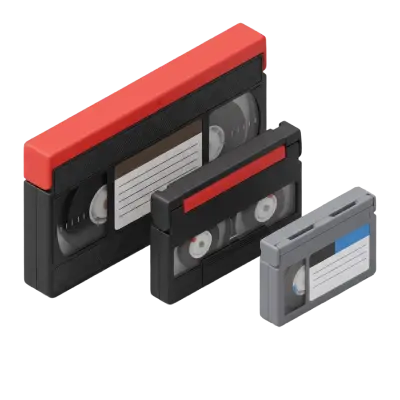
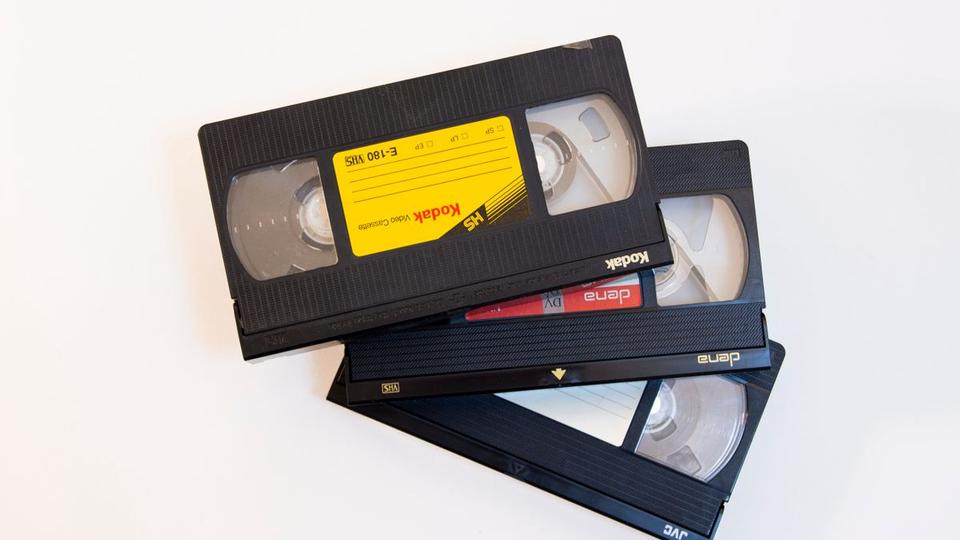
VHS tapes were produced in several formats — standard VHS, VHS-C, S-VHS, and S-VHS-C — that differ in size, recording capacity, and video quality. A full-size VHS cassette measures about 7.4 × 4.1 × 1 inches (188 × 104 × 25 mm) and records up to 2 hours at standard speed, while compact VHS-C camcorder tapes are roughly a third of the size. Knowing which type you have makes it easier to play, identify, and digitize your old tapes.

VHS came in more variety than most people realize. From full-size cassettes to compact camcorder tapes and higher-resolution S-VHS, each format served a different purpose — and each needs the right equipment to play back. This guide, prepared by Capture archival specialists, breaks down every VHS tape type, their dimensions and recording times, and how to preserve them.
VHS tape types compared
Several VHS formats were developed over the years, each catering to different needs:
Format | Size | Best for | Notes |
|---|---|---|---|
Standard VHS | Full-size | Home movies, prerecorded films | The classic format; plays in any VCR |
VHS-C | Compact | Camcorders | Plays in a VCR using an adapter |
S-VHS | Full-size | Higher-quality recording | Sharper picture (~400 lines); needs an S-VHS VCR |
S-VHS-C | Compact | Higher-quality camcorders | S-VHS quality in a compact shell |
D-VHS | Full-size | Digital/HD recording | Rare; digital video on a VHS-shaped cassette |
Standard VHS is by far the most common, and if you have small camcorder tapes, they're most likely VHS-C, which need an adapter to play in a regular VCR.
The higher-quality S-VHS format looks similar to standard VHS but records a sharper image — though it requires an S-VHS-compatible player to see the difference.
VHS sizes and dimensions
The two sizes most people encounter are full-size VHS and compact VHS-C:
Tape | Dimensions (inches) | Dimensions (mm) |
|---|---|---|
Standard VHS / S-VHS | 7.4 × 4.1 × 1 in | 188 × 104 × 25 mm |
VHS-C / S-VHS-C | 3.6 × 2.3 × 0.9 in | 92 × 59 × 23 mm |
A full-size VHS cassette is about the size of a paperback book, while a VHS-C tape is small enough to fit in your palm — which is exactly why it was used in camcorders.
Tape lengths and recording times
A VHS tape's recording time depends on both the tape length and the speed the VCR uses. Slower speeds fit more footage on the same tape, but reduce picture quality.
Tape | SP (best quality) | LP | EP/SLP (longest) |
|---|---|---|---|
T-120 (most common) | 2 hours | 4 hours | 6 hours |
T-160 | ~2 hr 40 min | ~5 hr 20 min | ~8 hours |
T-180 | 3 hours | 6 hours | 9 hours |
VHS-C (TC-30) | 30 min | 1 hour | 1 hr 30 min |
If your home recordings look grainier than a store-bought movie, they were likely recorded in LP or EP mode to save tape.
Regional standards: NTSC, PAL, SECAM
VHS tapes were recorded in one of three regional color standards, and a tape recorded in one often won't play correctly on a player built for another:
NTSC — 525 lines, used in North America and Japan.
PAL — 625 lines, used across most of Europe, Australia, and much of Asia.
SECAM — 625 lines with different color encoding, used in France, Russia, and parts of the Middle East and Africa.
This matters most if you've inherited tapes from another country — a professional service can handle formats a standard home VCR can't.
Why identifying your tapes matters
Knowing your tape type tells you what equipment you need and how best to preserve it. But whatever format you have, VHS tapes have a limited lifespan — the magnetic signal fades and the tape degrades over time, so identifying and digitizing them sooner rather than later is the safest move.
VHS also has a rich history — understanding when VHS was invented explains why so many family memories ended up on these cassettes in the first place.
Its dominance also came down to how it won the format war against Betamax, which cemented VHS as the home-video standard for decades.
VHS tape FAQs
What are the different types of VHS tapes?
The main types are standard VHS (full-size), VHS-C (compact camcorder tapes), S-VHS (higher-resolution full-size), S-VHS-C (compact S-VHS), and the rare digital D-VHS. Standard VHS and VHS-C are by far the most common in home collections.
What are the dimensions of a standard VHS tape?
A full-size VHS (or S-VHS) cassette measures about 7.4 × 4.1 × 1 inches (188 × 104 × 25 mm). Compact VHS-C tapes are roughly 3.6 × 2.3 × 0.9 inches (92 × 59 × 23 mm).
How long can a VHS tape record?
A standard T-120 tape records 2 hours at SP (best quality), 4 hours at LP, or 6 hours at EP. Longer tapes like T-160 and T-180 record more, and VHS-C camcorder tapes typically hold 30 minutes at SP.
What's the difference between VHS and VHS-C?
VHS-C is a compact version of VHS used in camcorders. The tape inside is the same, so VHS-C plays in a standard VCR using an adapter — it's just a smaller cassette shell.
Can you still play and digitize VHS tapes?
Yes, if you have a working VCR (and an adapter for VHS-C). Since VCRs and tapes are both disappearing, many people digitize their VHS home movies instead, which preserves the footage permanently.
Dust off those memories and make them last
Whatever VHS formats are sitting in your closet, they won't last forever — and the players to read them are getting harder to find. Identifying your tapes is the first step; digitizing them is what keeps the memories safe. Capture can turn your VHS tapes into digital files, handling every format from standard VHS to VHS-C and S-VHS, with your originals returned.
Bring your memories back to life.
You May Also Like
How AI Video Upscaling Works: De-interlacing, Noise Reduction, and Resolution Scaling Explained
AI video upscaling works in three stages: the original tape is captured using broadcast-grade equipment to extract the cleanest possible signal, encoded into a lossless ProRes master file, then processed frame-by-frame by neural networks that remove interlacing artifacts and increase the resolution to 1080p or 4K. Unlike a standard 1:1 transfer, the AI analyzes each frame individually — inferring missing detail from surrounding pixels and learned patterns — while preserving the original frame rate throughout.

Choosing the Perfect Film Video Camera: Top 10 Recommendations for Filmmakers
Film video cameras record motion by capturing a rapid sequence of still images on photographic film — typically at 24 frames per second for cinema and 16–18 fps for home formats like 8mm and Super 8. Unlike digital video, film requires chemical development before it can be viewed, and the footage degrades over time without proper cold, dry storage.

Five Super 8 Projectors That Stand the Test of Time
Super 8 projectors operate similarly to standard 8mm projectors but are not interchangeable — Super 8 film has a different sprocket hole size and frame dimension than regular 8mm. Kodak introduced Super 8 in 1965 alongside a cartridge-loading system that eliminated manual threading. Working Super 8 projectors are available used through eBay and estate sales, though lamp replacements are increasingly difficult to source.