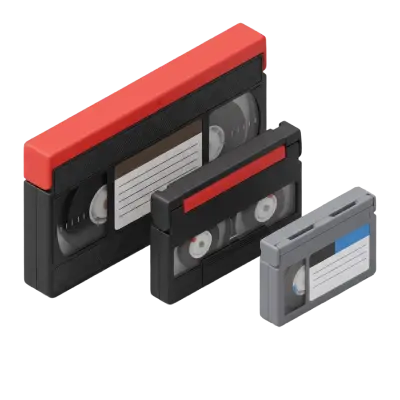
5 Reasons to Digitize Your Home Movies in 2026
From AI-powered upscaling to the last generation of working playback equipment, here's why 2026 is the year to finally convert your tapes.
Why This Year Matters More Than Ever
Every year we say "don't wait," and every year it becomes more true. Here are five concrete reasons why 2026 is the inflection point.
1. AI Upscaling Has Reached a Tipping Point
The AI models available today can take a fuzzy 480i VHS signal and intelligently upscale it to 1080p or even 4K. We're not talking about simple sharpening — these neural networks understand faces, textures, and motion to reconstruct detail that was never visible before.
Two years ago, this technology was experimental. Today, it's production-ready and included in every order.
2. Playback Equipment Is Disappearing
The last VCR was manufactured in 2016. Professional-grade playback decks are being retired from broadcast facilities. The supply of working, well-calibrated machines shrinks every year, and replacement parts are increasingly fabricated by hand.
Within 5-10 years, finding a facility with broadcast-quality playback equipment will be extremely difficult — and extremely expensive.
3. Your Tapes Are 20-40 Years Old Now
Do the math. A tape recorded in 1990 is 36 years old. The magnetic particles have been slowly losing their charge for decades. The binder is absorbing moisture. The base film is becoming brittle.
The quality you can capture today is the best it will ever be. Tomorrow it will be slightly worse.
4. Cloud Storage Is Cheaper Than Ever
Storing your digitized memories in the cloud costs almost nothing. A typical family's entire tape collection — digitized in full HD — might total 50-100GB. That's a fraction of what most people pay for cloud storage they're already not using.
5. Sharing Has Never Been Easier
Once your memories are digital, you can share them instantly. Text a clip to your sibling. Create a family YouTube channel. Put together a montage for Grandma's birthday. Make it your screen saver.
Physical tapes can only be in one place at a time. Digital files can be everywhere, for everyone, forever.
The Real Cost of Waiting
It's not just about quality loss. It's about the stories those tapes hold. Every family gathering, every holiday, every mundane Tuesday that you'd give anything to relive — they're all trapped on magnetic tape, slowly fading.
The cost of digitizing is a fraction of what those moments are worth. And the cost of waiting is that some of those moments may be lost entirely.
Bring your memories back to life.
You May Also Like

Does Walgreens Transfer VHS Tapes and Photos to Digital? What to Know Before You Decide
Yes, Walgreens transfers VHS tapes, film, photos, negatives, and slides to digital — but the work is outsourced to iMemories, not done in-store. Video converts to DVD, Blu-ray, or cloud; photos convert to USB only. Turnaround typically runs 3–5 weeks.
Forever Studios Reviews 2026: Is It Worth It? Quality, Pricing & Comparison
Yes, Forever Studios is a legitimate digitizing service. Based in Boca Raton, Florida, it specializes in transferring VHS tapes, camcorder tapes, film reels, photos, slides, negatives, and audio cassettes to digital formats. Most Forever Studios reviews praise the company's restoration quality and careful handling of sentimental media. The most common criticisms focus on quote-based pricing, longer-than-expected turnaround for some orders, and uncertainty over whether the Forever Gold upgrade delivers enough additional value. If preserving aging videotapes is your priority, Capture's VHS to Digital service includes published pricing, AI-enhanced restoration, and predictable turnaround times, making it easier to compare before placing an order.